Sunday, January 25, 2009

Sherlock Holmes as Iron Man?

I'll admit it--my Special Lady and I walked out of Iron Man. I love superhero movies, and I have a special place in my heart for Robert Downey, Jr., as I do for pretty much all celebrities who struggle with addiction (even Lindsay and Britney get a level of immunity), but I just couldn't take Iron Man. We went to see it at a big theater, and the crowd was so jingoistic and creepy, I had this moment when I found myself suddenly unable to approach the film as a Big Dumb Action Movie--and if I had to sit there while people cheered as another Afghan village exploded, I would start to cry. And don't even get me started on Gwyneth frakkin' Paltrow.

So I met this news that Guy Ritchie is making an "updated" Sherlock Holmes movie with trepadation, to say the least. Like Iron Man, most Guy Ritchie movies seem to try for irony around their masculine posturing, but ultimately find themselves way too invested in that posture for the irony to really take. The fast editing and ass-kicking are over the top, but the characters never reach the self-aware (or even accidental) self-parody of a Nathan Fillion or Shatner or Mark Wahlberg.

The figure of Sherlock Holmes offers a chance to present a different vision of masculinity--he's always struck me as sad and vulnerable, with his obsessions (the OCD stuff, obviously, but also his obsession with Watson) blocking him from the world of male privilege where he would otherwise be able to succeed. This strikes me as a particularly feminine conundrum--where your skills prevent you from getting what you want, rather than bringing you toward it. I think of it as the Lisa Simpson Syndrome: intelligence and skills mark you as weirdo instead of a Success.

And part of this feeling must come with the historic physical characterization of Holmes, which it's impossible not to think of (the coat, the hat, the big pipe, etc). He just doesn't look like an action hero, which is why I think he works as a hero for braniacs, misfits, and nebbishes. Guy Ritchie just seems like another guy who'd beat you up for your lunch money--or at least idolize the guy who could.

So here's hoping this turns into gay camp, à la my favorite gay male love story ever. I doubt it, but anything's possible.

Monday, January 12, 2009

Felix "Gay-dis" Gaeta


I was bonding recently with a professor in my department over the awesomeness that is Battlestar Galactica. We agreed (as anyone does who's seen the show) that it's awesome, but she complained that its homophobia drove her crazy. Ever eager to defend my baby, I replied that I had heard they were outing Gaeta in the new set of webisodes, “Face of the Enemy” --to which she mumbled something and changed the subject. I felt a little dumb after this, like I'd boiled a complex issue down to a question of representation--if they have queer characters (finally!), then the show must be queer-friendly, right?

Obviously, there's more to it than that, but I don't want to downplay how shocking it still is to see two guys kiss as part of a mainstream TV narrative (even if they only get to be gay on the internet, like closeted rural teenagers). The show goes out of its way to demonstrate how okay everyone is with Gaeta's gay-i-tude, from Racetrack gently ribbing Hoshi (that's the BF) for how long it took them to get together, to Tigh's accepting their relationship as a reason to give Hoshi a raptor to go find Gaeta's lost ship. Furthermore, I really appreciated how Gaeta's sexuality was presented as more nuanced than the straight/gay binary--his romantic/sexual connection with the Eight seems real enough, but isn't used as a way to delegitimize his desire for Hoshi or his queerness in general. At the end of the day, though, I had much the same feeling that I did after watching “Razor”--the moments when the show explicitly addresses questions of sexual diversity just highlight the narrative's structural homophobia.

“Razor's” retrograde politics are pretty obvious--Cain's lesbianism is a sign of her over-the-top masculinity, and thus her failure to be a successful “parent” for the Pegasus. This fear of a queer familial structure is particularly striking when you consider the insistent comparisons made between Pegasus as the failed family (that has to sacrifice itself if the future is to survive) and the stabilizing force of Galactica's heterosexual parental dyad of Adama and Roslin. But even more than that, I think there's something really important in how the thing that the Cylons most desire in/from the humans is the ability to heterosexually reproduce. What makes the Cylons monstrous is their attraction across sameness and their ability to regenerate by means other than reproduction. “Love” is what makes Hera's and (maybe...) Nicky's conceptions possible, and it seems the show implies the same origin with the fetus conceived by Six and Tigh. If love = reproduction, what does that mean for queer characters? Especially when reproduction is the activity that marks you not just as straight, but as human?

I don't know--maybe I'm oversimplifying things. The way the Final Five are obviously in between human and Cylon shows a breakdown of boundaries between categories of identity that serves as a counterpoint to all this obsession with reproduction and family structure. And Baltar's effeminacy certainly isn't linked to any lack of virility on his part. And even if his desires are marked as perverse (which I think they pretty definitely are), I don't think the show pathologizes his investment in sexual pleasure for its own sake. We'll see--but I'm excited for Friday, and to see where all this goes in the next season, particularly w/r/t the relationship between Tigh and the Six.

Sunday, January 4, 2009

Feeling dissed...

So I'm deep in the zone right now, working on my dissertation, and frozen by terror in a way that surpasses all my school-related freakouts in recent memory. For those of you among my five readers who have done this before, any tips for pushing through the terror that comes with the first piece of writing you give your advisor?

On top of my general malaise, I've somehow misplaced the central theoretical text I'm using. I can only take comfort in the fact that the same thing happened to my blushing bride, and she managed to finish her prospectus. Thank god we don't have a baby, we'd probably just leave it on the T.

So here's my hope, put out into the wide, wide worldwide web:
I will be motivated by my love of serial reading, not my fear of failure;
I will commit myself wholeheartedly to the play of language;
I will refrain from making Grand Pronouncements;
I will treat my fellow writers and readers with respect;
I will remember always that the object of all interpretation is the process.

Wish me luck, friends.

Saturday, October 4, 2008

Blake's Got a New Face


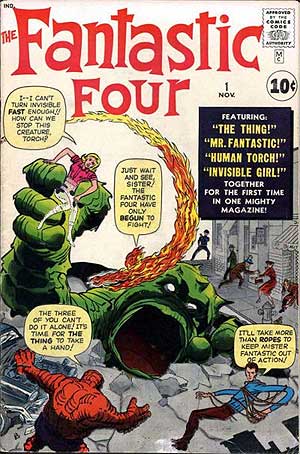
Which is...the author of the first ever superhero comic!!

I'm co-teaching a course on visual narrative right now, and we're reading Blake, who is blowing my mind, again. One of the things I kept thinking about during our discussion on Friday was how much the illustrations in "America: A Prophecy" remind me of old school superhero comics. This larger-than-life, four-color madness particularly shines through in the image of Orc (?) chasing Albion (?) through the sky. Even distinct from the images, the way all of the characters in "America" stand in for larger concepts and can only be understood in relation to each other reminds me of the Justice League of America or the X-Men. (Paine and Washington band together with special powers from Orc to defeat the fascist Urizen! Tune in next week for the exciting conclusion!)

In a conversation with a friend this weekend, he asked me why I like superhero comics at all, since they're so dominant within the form. How can there possibly be anything new to say through superheroes? Because I've been thinking so much about Blake lately, I realized that superheroes challenge us to consider oppositions--both how we depend on binaries to make sense of the world, and how those binary systems of thinking always eventually fail us. (The last page of Alan Moore's Batman story The Killing Joke, in which the Joker and Batman are on the verge of killing each other but can't stop laughing is a great example of this--sadly, I can't find an image to link to.)

The particular value of Blake in this conversation, and why I think you can make the argument for Blake as a superhero comic artist, is how he makes the link between allegory, binary structures of thought, and the formal relationship between word and image so clear. What Blake shows us, particularly in "America," is how reading an image-text is always about negotiating the difference between word and image, and finding the place that is both in between these two modes of understanding and in them at the same time. Not either/or, but both/and. Superheroes demand that same trick of thinking, crossing the gap between good and evil and seeing how neither of those definitions are sufficient, even as we're confronted with how much we need them in order to make sense of the world at all. Also, I think the model of the superhero comic gives us a new way of thinking about Blake's negotiation between the weighty, self-serious business of prophecy and the pleasure he clearly takes in illustrating these images (and the pleasure he encourages the reader to take in reading them).

What do you think? Is it too big a leap to claim Blake within the comics pantheon?

Sunday, September 14, 2008

RIP DFW

So David Foster Wallace hung himself last Friday, on my birthday. I feel stupid saying this, but I feel like I've lost a friend. This feeling is only made more intense by Wallace's frustratingly ever-present self-loathing and his questionable politics. I've greeted all these pieces of news about DFW as a person with the same emotions that accompany my brother's Republican sympathies and huge house in Scarsdale: he's a lunatic, but I know what he's about deep down, and we're ultimately the same, so I love him enough to take his lunatic choices in stride.

Infinite Jest
saved my life when I first read it in 1998. I'd just gotten sober, and it made sense to me in a way that the approved AA literature just never ever did. Honest and heartbreaking and self-conscious and funny, Wallace made me believe that sobriety could be the beginning of something, not just a bleak ending. That my life could undergo a transformation as radical as what Wallace was able to do with the form of the novel. The sense of Identification Wallace inspired in me as a writer made me able to Identify in meetings, and I'm not exaggerating when I say that this is probably why I'm alive at all to try to eulogize him in tragically (appropriately) insufficient terms.

So, in the spirit of Identification, here is an incredible passage (long, but that's the only way with him) chosen essentially at random from Infinite Jest. I hope you're smoking cigarettes with Elliot Smith at the big meeting in the sky, my friend.

"If you listen for the similarities, all these speakers' Substance-careers seem to terminate at the same cliff's edge. You are now Finished, as a Substance-user. It's the jumping-off place. You now have two choices. You can either eliminate your own map for keeps--blades are the best, or else pills, or there's always quietly sucking off the exhaust pipe of your repossessable car in the bank-owned garage of your familyless home. Something whimpery instead of banging. Better clean and quiet and (since your whole career's been one long futile flight from pain) painless. Though of the alcoholics and drug addicts who compose over 70% of a given year's suicides, some try to go out with a last great garish Balaclavan gesture: one longtime member of the White Flag Group is a prognathous lady named Louise B. who tried to take a map-eliminating dive off the old Hancock Building downtown in B.S. '81 but got caught in the gust of a rising thermal only six flights off the roof and got blown cartwheeling back up and in through the smoked-glass window of an arbitrage firm's suite on the thirty-fourth floor, ending up sprawled prone on a high-gloss conference table with only lacerations and a compound of the collarbone and an experience that has left her rabidly Christian--rabidly, as in foam--so that she's comparatively ignored and avoided, though her AA story, being just like everybody else's but more spectacular, has become metro Boston AA myth. But so when you get to this jumping-off place at the Finish of your Substance-career you can either take up the Luger or blade and eliminate your own personal map--this can be at age sixty, or twenty-seven, or seventeen--or you can get your the very beginning of the Yellow Pages or InterNet Psych-Svce File and make a blubbering 0200h. phone call and admit to a gentle grandparentish voice that you're in trouble, deadly serious trouble, and the voice will try to soothe you into hanging on until a couple hours of go by and two pleasantly earnest, weirdly calm guys in conservative attire appear smiling at your door sometime before dawn and speak quietly to you for hours and leave you not remembering anything from what they said except the sense that they used to be eerily like you , just where you are, utterly fucked, and but now somehow aren't anymore, fucked like you, at least they didn't seem like they were, unless the whole thing's some incredibly involved scam, this AA thing, and so but anyway you sit there on what's left of your furniture in the lavender dawnlight and realize that by now you literally have no other choices besides trying this AA thing or else eliminating your own map, so you spend the day killing every last bit of every Substance you've got in one last joyless bitter farewell binge and resolve, the next day, to go ahead and swallow your pride and maybe your common sense too and try these meetings of this 'Program' that is a best probably just some Unitarian happy horseshit and at worst is a cover for some glazed and canny cult-type thing where they'll keep you sober by making you spend twenty hours a day selling cellophane cones of artificial flowers on the median strips of heavy-flow roads. And what defines this cliffish nexus of exactly two total choices, this miserable road-fork Boston AA calls your Bottom, is that at this point you feel like maybe selling flowers on median strips might not be so bad, not compared to what you've got going, personally, at this juncture. And this, at root, is what unites Boston AA: it turns out that this same resigned, miserable, brainwash-and-exploit-me-if-that's-what-it-takes-type desperation has been the jumping-off place for just about every AA you meet, it emerges, once you've actually gotten it up to stop darting in and out of the big meetings and start walking up with your wet hand out and trying to actually personally meet some Boston AAs. As the one particular tough old guy or lady you're always particularly scared of and drawn to says, nobody ever Comes In because things were going really well and they just wanted to round out their PM social calendar. Everybody, but everybody Comes In dead-eyed and puke-white and with their face hanging down around their knees and with a well-thumbed firearm-and-ordnance mail-order catalogue kept safe and available at home, map-wise, for when this last desperate resort of hugs and clichés turns out to be just happy horseshit, for you. You are not unique, they'll say: this initial hopelessness unites every soul in this broad cold salad-bar'd hall. They are like Hindenburg-survivors. Every meeting is a reunion, once you've been in for a while. (347-9)

Wednesday, August 13, 2008

An open query

So I'm at a bit of a loss right now as to what novel I should teach in my English 1 class next semester. We usually read a novel and then watch a film that's in conversation with it. I try to stay away from adaptations, just because the relationship is too one-to-one to generate as dynamic a conversation as I'd like. In the past, we've read Dracula and watched "Buffy Vs. Dracula," and read Jane Eyre and watched Rebecca. I was thinking it would be fun to read Jane Austen this time around, but I'll be goddamned if I'm going to watch Bridget Jones' Stupid Diary ever, ever again, and I'm a little scared at the prospect of teaching Emma, which I remember as being a little inaccessible for undergraduates. So my question is this: does anyone know other good loose adaptations of Pride and Prejudice? I'm excited about Mansfield Park (my favorite Austen novel), but again, I'm worried that undergrads might be bored. Any thoughts?

Put another (more interactive, less obviously pitched at other teachers) way, what pairing of Jane Austen novel and film would you most like to have thought about as an incoming freshman and why?

Sincerely,
Your Friendly Neighbourhood Janeite

Monday, August 4, 2008

Feminists, Musicals, Sex-Crazed Vampires: Performance among/and Art Fans


1) The Guerilla Girls

“Are the Guerilla Girls really necessary? Take a little test. On one side of a piece of paper, list all of the female artists you've heard of. On the other side of the paper, list the male artists.”
-essortment guide to the Guerilla Girls

It might be easy to forget how few women artists are represented in the Metropolitan Museum of Art in New York--after all, so many of the paintings (especially the naked ones) are of women. The Guerilla Girls are out to change that, one piece of guerilla art at a time.

The Guerilla Girls formed in 1985 as a reaction to an exhibition at MoMA called “An International Survey of Painting and Sculpture.” Out of 169 featured artists, only three were women. Adding insult to injury, the curator publicly stated that any artist whose work was missing from the show should “seriously rethink his [sic] career.” A group of local artists protested the opening, but only managed to piss off patrons and industry bigwigs alike. (Darn those shrill, shrill feminists!) So, in a decision that ultimately matched form to function, they decided to stage their protest as a piece of performance art, hiding their identities and letting the information speak for itself. The Guerrilla Girls make public appearances and conduct interviews, but only while wearing gorilla masks, and only using names of dead female artists. In this way, they can advocate for the value of these sometimes forgotten artists, protect their own careers, and keep the focus on the depressing statistics that form the core of their message (for example, only 3% of the artists in the modern section of the Met are women).

Although they began by focusing their energy on the New York art world, emphasizing inequity in museums and the art world as a whole, they've since shifted their energy to Hollywood, where the situation for female directors and producers is even worse. They posted billboard in LA advertising the gender inequity of Oscars and the absence of any feminist historical perspective in Hollywood films. Their most engaging work, however (if you ask me), is their political posters. Check out this amazing sendup of the “Terror Alert System,” and this shield against the groping paw of the Governator.

I realize this is a departure from my usual focus on fans in this blog, but I think the Guerrilla Girls show the most awesome end point of the resistant power of fan art--using the form of something you love (postmodern art, in this case) as a framework for pointing out the things in it that make you crazy.

2) Andrew Lloyd Webber

Secret love/ secret shame of theater geeks everywhere, Webber is simultaneously an example of what's wrong with theater and what's right. His work brought musicals into the modern era, incorporating lots of different styles, garnering a huge following, and even getting knighted (!)--but his shows are for the most part grindingly repetitive and, well, bad (and this from the girl who can recite the entire libretto of Evita from memory). So the question is, what desire does Webber tap into? What's at the source of his appeal?

I don't have a simple answer to that question, but I do think part of the reason for Webber's popularity has to do with spectacle and seriousness. The musical that really changed things for him was Jesus Christ Superstar (1972), where he moved from the campy pastiche of Joseph and the Amazing Technicolor Dreamcoat (1970) to the overblown soaring solos that became his signature (I'm thinking specifically of “I Don't Know How to Love Him). Ultimately, then, I think Webber's popularity is about his ability to do camp (or something that should be camp) seriously--he gets at the seriousness of opera (particularly in Phantom of the Opera (1986), his most famous show) but also the accessibility of big-budget megamusicals like My Fair Lady (1956) or Oklahoma! (1943). This makes him ideal fodder for ten-year-old girls who want to be the next American Idol or at least wear a cat suit on stage (I don't blame you, for the record, if you can't bear clicking on all of these links).

Although Webber was not directly involved with Les Miserables (1985) or Miss Saigon (1989), the success of Evita (1978) and Phantom of the Opera laid the groundwork for those, and these later musicals bear much of the same appeal--big budgets, elaborate sets, insistent refrains, soaringly Serious Solos. The influence of these shows on pop culture can be seen in the way musical parodies get structured, and in how we understand the iconic nature of women in power.

3) The Rocky Horror Picture Show

A rite of passage for freaks and theater geeks everywhere, The Rocky Horror Picture Show is a 1970s B-movie transformed into a piece of participatory theater. Midnight movies always have cult value--who but a fanatic will leave their house for a movie in the middle of the night? Over time, though, Rocky Horror has become the Midnight Movie that defines Midnight Movies, with showings in West Des Moines, IA and Hobart, IN. In this way, it serves as a kind of entré into freak culture for people in areas that might not have the most thriving cultural scene. This was certainly the case for me, heading into the Twin Cities from my sleepy suburb of Minnetonka, MN. My parents were out of town and I had a fever of 102, so I don't remember much beyond a heady combination of rebellion and flu medicine, but afterward, I felt like a Real Freak (which was exciting).

The basic formula for Rocky Horror is like Mystery Science Theatre 3000--people yell back at the screen in response to stupid character decisions or bad acting, or as a way of participating in the action of the film. The content of the film itself might be part of what marks Rocky Horror as particularly freak-friendly. Tim Curry (whom you might remember as Wadsworth from Clue or the super-scary clown from It) plays Dr. Frank-n-Furter, a “Sweet Transvestite from Transsexual Transyvania”--the owner of the Gothic mansion where middle-American bourgies Brad and Janet find themselves after getting lost in the woods. Like horror protagonists everywhere, Brad and Janet get more than they bargained for with their stop, and they both get tricked into sleeping with Frank-n-Furter (and into eating Meat Loaf--the actor, not the dinner!).

Fans understandably see Frank-n-Furter's castle as a kind of anything-goes playground, and the atmosphere at a midnight show feels a lot like the party Brad and Janet first walk in on. People bring props to throw at the screen at the appropriate time, and virgins (first-time viewers) have to undergo initiation while hard-core fans act out the show on a stage in front of the screen. It's similar to a Star Trek convention in that there's a funny balance at a Rocky Horror show between a pressure to be the most hard-core in your knowledge/fandom and a profound sense of inclusion for all fringey types. It's strange, now, how the show has become such an institution. There's a weirdly official “preservation society” for maintaining shows in These Modern Times. And it's hard to take something's fringe appeal seriously when it's praised on The Drew Carey Show.

On another note, this is the last post that I'm doing for the class I've been teaching. From here on out, things will be a little less structured and listy, but also hopefully a little more frequent, and more focused on serials and all things dissertatey. Any ideas? Requests?