Showing posts with label fans. Show all posts

Friday, August 7, 2009

Caution: Spoilers Ahead?


So I'm again inspired by Joss Whedon and the frustrating pleasures of Dollhouse to return to this blog. I've just watched the famous unaired final episode, and I'm unsure what to make of it. I'll do the standard caveat against spoilers here, but I'm not sure if it's even valid, since the episode both is and isn't part of the show's “official” arc. Whedon himself was, unsurprisingly perhaps, given his history in comics and tendency to play with canonical backstory, a little cagey about the canonical value of the episode in the Dollhouse panel at Comic-Con. His full response boils down to this: “Everything that happens is real, but they're memories, so not reliable.” In other words, the writers can change things if the story demands it or if they feel like it--everything is open to a possible reboot.

If I sound churlish, I don't mean to--I'm excited at the prospect of a changing definition of continuity, or at least I am if it's happening in the hands of Joss Whedon, who's particularly good at this kind of narrative innovation. I think the introduction of Dawn, for instance, was one of the most interesting and ballsiest moves he could have made, particularly considering that Buffy was on the air well before the massive popularity of LOST's twisty logic.

Anyway, here's what happens in the episode: it takes place in 2019, ten years after the events of the first season, and LA is a postapocalyptic nightmare. The dollhouse technology has spun out of control (surprise!), and it's impossible to tell if people are “actually” who they seem or if they've been wiped. On top of that, there are armies of “butchers”: people who seem to have been wiped and turned into mindless killers (shades of the long-term themes of Firefly). A group of Scrappy Survivors (featuring awesome girl geek Felicia Day) discovers the abandoned dollhouse, and goes there to take cover from the war above. So already, the show's ultimate endgame is revealed. Any reader who is familiar with the genre at all could see the catastrophic effects of the dollhouse technology coming, but the thing that became increasingly surprising to me as the show went on was the level of detail we get as to how everything fell apart.

Because it turns out that the postapocalyptic story is just the frame for a Cliff-Notes-style summary of how the world exploded. Whenever the shit came down, Dushku and Co. left a trail of bread crumbs in the form of stored memories that will tell any remaining survivors how to get to a mythic “Safe Haven” (and, more importantly, fill the reader in on all the important bits that we missed in getting from Here to There). So we learn, in five-minute bursts, that Echo/Caroline has learned to maintain a coherent personality, that Rossum expands the Dollhouse's services to giving “anatomical upgrades” to people, that Rossum has been secretly uploading memories every time anyone gets in an MRI, and that someone (Rossum, presumably) weaponizes the Dollhouse tech so that picking up a phone puts you at risk of becoming a mindless zombie.

It's all awesome SF, and cobbled together to make something new in a way that showcases Whedon's talent for generic pastiche. But here's the thing that gets me--what happens now to the kinds of pleasure that we assume serial reading is meant to provide? Why warn about spoilers when the show itself has already laid out its next five years of plot in a single hour? And will that information about the show's future be available to everyone, or just to people who care enough about the show to buy the DVDs? After watching it, I figured that the next season might even begin without any allusion to “Epitaph One” at all--it would be like an easter egg, only available to the devoted fan. Apparently, though, three of the characters from the apocalyptic future show up in the season two premiere, so casual viewers will at least have a taste of what the future of Dollhouse holds, but not the broad overview that the “real” fan now knows.

It's interesting to me, because the standing model so far for the distinction between the casual and devoted reader (at least with a show like Dollhouse) has been how committed that reader is to sorting out the show's central mystery. The one who's looking teleologically forward, obsessed with who killed Laura Palmer or what the numbers mean or who shot JR. But with Dollhouse, there's this assumption that readers are looking for a different kind of payoff--filling in the gaps, maybe? I'd say getting a deeper understanding of character, but that doesn't quite work with Dollhouse since the characters are by definition so empty...

Based on the little bit of internet stalking I've done so far around message boards and the like, it seems that people are mostly adopting this “we're in it for the journey, not the destination” angle. I'm curious as to how this will effect the show's direction in the coming year--but more importantly, if Joss Whedon has started another sea change in television like the one that began with Buffy. This time, though, instead of trusting readers to pay attention to longer and more complicated serial arcs, he's trusting readers to look for aesthetic rewards beyond What Happens Next--to think differently about their relationship with plot. Here's hoping.

Monday, July 28, 2008

Music Makes the People Come Together: Three Larger-Than-Life Artists or Groups


1. Elvis Aaron Presley

Velvet paintings. Buck knives with his picture emblazoned on the handle. Competing stamps with his “fat” and “thin” portraits. A ridiculous movie released eleven years after his death (and twenty years after his fame had peaked) about how he inspires suburban hippies toward patriotism. Clambake. Who could inspire all this fanmania but the King?

The question that always gets me about Elvis is why he inspired the level of fan attention that he did--why Elvis and not Buddy Holly or Jerry Lee Lewis? (Especially Jerry Lee Lewis, who was making music at the same time and had the same crossover appeal of taking black music into suburban white living rooms.) Obviously, capturing the cultural imagination is like catching lightning in a bottle, and there's never a simple answer as to why one star makes it over another, but I think Elvis's appeal is all about his ability to transgress boundaries of identity, particularly racial and sexual identity. He was dangerously masculine--courting 14-year-old Priscilla Presley and (according to urban legend) packing his jeans with the cardboard tube from inside a roll of paper towels to emphasize his...appeal. At the same time, however, he showed an effeminate vulnerability--his signature leg movements are rumored to have stemmed from uncontrollable nervous shaking, and he was an infamous "mama's boy."

This sexual ambiguity was only reinforced by his racial ambiguity. I'm not sure Steve Allen would have made him sing "Hound Dog" to an actual dog or Ed Sullivan would have refused to film Elvis below the waist if he didn't present the threat of miscegenation by being a white guy performing music that was so unmistakably "black." Of course, Elvis never would have been famous like he was if he'd actually been black--part of the controversy around him as a singer, then and now, is that he's among the first in a long line of singers from Elvis to Pat Boone to Vanilla Ice to Eminem to the Beastie Boys who've been accused of co-opting African-American music for a while middle-class audience. Elvis and Pat Boone deserve this accusation more than Eminem, The Beastie Boys, or even (shudder) Vanilla Ice, since Elvis and Pat Boone re-recorded songs written and already released by black artists like Big Mama Thornton and Fats Domino.

Once Elvis died, however, the nature of his popularity changed dramatically. Instead of race and sex, Elvis fans were obsessed with sex and death and thwarted potential. Elvis's famously excessive personal life captures fans' imagination these days. He's become a much more classically "cult" figure in death, with people positing connections between Elvis and aliens and claiming that he faked his death. The greatest cultural riff on Elvis's lasting cultural appeal (besides Colonel Homer, of course) would have to be the film Bubba Ho-Tep, starring Bruce Campbell and Ozzie Williams as Elvis and JFK, both of whom (the film argues) faked their own deaths. Don't question the logic--just watch the movie--it's awesome.

2. Madonna
If Elvis caught the cultural imagination around the relationship between race and sexuality, then Madonna has exploited our obsession with the relationship between gender and sexuality. As her name suggests, she's always interested in breaking down the virgin/whore dichotomy that structures so much of how people think about gender in our culture.

A confession: the first course I ever took in college was about Madonna, and although I didn't realize it at the time, I think it was there that my obsession with cultural studies started. Madonna garnered a ton of critical attention in the 1980s, and I've heard that it was impossible to go to an academic conference without seeing at least one Madonna paper, if not a whole panel. I remember watching the video for “Material Girl” in class, and then my teacher asking us why we thought feminists were mad about it. More than my answer, I remember being blown away that there was an academic conversation about Madonna at all. I imagine this is how my students feel about Buffy now.

How to characterize Madonna's different stages? There's Underwear Madonna of the early 80s, when she performed at the MTV video music awards and launched a thousand “wannabes.”; scary dominartix Madonna; Evita Madonna, the Serious Actress; Spiritual Madonna, coming back after 40 with Ray of Light, kaballah, and a brand-new British accent; Britney Spears makeout partner and adoption-loophole US Weekly fodder Madonna (her current incarnation). So many different social anxieties seem to coalesce around her: fear of aging, partly, but mostly she seems to address the problem of how American culture can handle an economically and sexually powerful woman. She's interesting to critics because she's infuriating--playing off the cultural stereotypes that have kept her down, but incorporating them into her own image.

Her relationship to the aging process has unsurprisingly taken center stage of late--she turns fifty on August 16 (of course she's a Leo), and so much of the fan art she's inspired revolves around her ability to constantly reinvent herself--and by being constantly new, she never has to worry about getting old.

3. The Grateful Dead
Although you can buy Grateful Dead albums at a store or online (American Beauty is their best, I think), the real deal with this band is live shows. They've been touring nonstop since 1965--have continued touring even after Jerry Garcia's death in 1995 under the new monikers "RatDog" and “The Other Ones.” As this second name suggests, Jerry Garcia was the heart of the band.

The mythology of the Grateful Dead is deeply hooked into that of free love and huge festival shows like Woodstock. As such, the music is only part of the appeal of a Dead show. People follow the band around for years, trading bootleg tapes and selling clothes and bags and jewelry at the shows as ways to make money. Fans love their music, of course, but the real deal is the show itself, and the opportunity it offers to form an alternative community based in free love and free drugs. The connection among freaks and hippies (and the way this connection is always measured against "straight" culture") is awesomely characterized (again), by the greatest television show ever, Freaks and Geeks. This blog entry, too, shows how fans narrate their love for the band like a religious conversion: I was trapped by bourgeois mainstream culture, but then the Doors of Perception opened in my mind and I saw the Beauty of Music. I was Lost, but now I'm Found.

This ethic of the always-touring, drug-addled band has been reproduced in bands like Ween and Phish over the years. Even festivals like Lollapalooza and Bonnaroo, while they feature bands thoroughly disconnected from the free love vibe of the Dead, still build on that pattern of sprawling days-long shows and alternative fan-based communities.

Monday, July 7, 2008

Let's put the "iterate" back in "literate": 5 novelists with cult followings


1. Charles Dickens


When people talk about the literary/high-culture value of “quality television” like The Sopranos and The Wire, they often refer to these texts as “the new Dickens.” Presumably, this comparison is meant to elevate the former--if The Wire is like Dickens, then watching TV could be good for you, right?

Maybe Matthew Arnold was right, and what this really means is that Dickens was a lowbrow panderer, just like all those soulless TV execs, but I choose instead to see the parallels between Dickens' work and contemporary televised serials as a sign of the aesthetic and cultural possibilities of television. Structurally, Dickens' serials share a number of story elements with contemporary serials: multiplot and densely layered stories, grotesque characters, and melodramatic/gothic elements.

At the same time, noticing this parallel offers us a chance to rethink Dickens as a fan phenomenon, on the level of famous contemporary serials like LOST or Star Trek. At the time of their release, the books were hugely popular both in England and America. Famously, when the final installment reached American shores, there was a crowd greeting the boat with the question "does Little Nell die?" This pressing need to know What Happens Next is at the core of many if not most cult texts, and Dickens is no exception.

Like his less legit contemporary brethren, Dickens has inspired fan fiction, reenactments by fans, and even theme parks (Star Trek only has a casino). Even in the realm of academia, there's a shockingly similar vibe among a group of hard-core Dickens scholars as there is at a Star Trek convention. It's not just by chance, I think, that the most famous annual Dickens conference is maybe the only academic environment where you could find a Victorian Ball. Which people attend in costume.

2. J.K. Rowling/ Harry Potter
Rowling, too, is frequently praised in terms of her similarity to Dickens. This is perhaps a more intuitive link, not just because she writes immensely popular serialized novels that are deeply rooted in the minutiae of British culture, but because she has captured the Anglo-American cultural imagination so thoroughly.

The thing that's particularly interesting to me, however, about Rowling is her intensely proprietary relationship to her characters. Her declaration of Dumbledore's secret gay history came months after the final book in the series had been published. Rather than leaving the matter open for fans to discuss in the forum of a classic critical conversation or through dueling fanfics, Rowling seemingly closed the book on the matter (as it were)--and by declaring Dumbledore officially gay, she precluded the possibility of other characters' queerness being “discovered” by fans. After all, if Rowling has definitively stated that Dumbledore is gay, then we can all stop wondering about the possibility of a love connection between, say, Harry and Draco. Rebecca Traister from Salon.com has an interesting take on Rowling's “outing” of Dumbledore which you can access here.

Like Dickens' struggle over copyright laws, Rowling has attempted to control fan activity w/r/t the Wizarding Universe she created, recently suing the creators of the Harry Potter Lexicon, a website that offers definitions of everything from Abraxan to Zonko's Joke Shop. Rowling used the web site herself as a resource when making a timeline for the film version of Goblet of Fire, but when its creators wanted to publish a hardcover version of the book, Rowling had a litigious fit, claiming that the printed lexicon would preempt her as-yet-unwritten Harry Potter Encyclopedia, and thus infringe on her authorial rights.
Both the Lexicon and Dumbledore's belated coming-out party place Rowling at the center of an ongoing argument over the power of the author and what defines authorship itself. As yet, puppet shows and middle school dance squads aren't considered copyright infringements, but Rowling's vexed relationship with fan activity opens up the question of where (or whether) the line can be drawn between interpretation, appreciation, and "infringement."

3. J.R.R. Tolkien and The Fellowship of the Ring
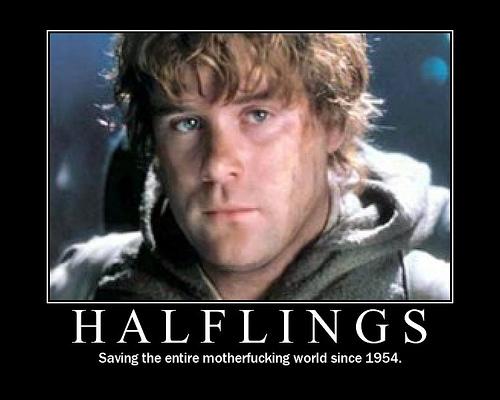
It would be impossible to talk about cult fiction without mentioning Tolkien: the "father of high fantasy" and the patron saint of the twenty-sided die. Tolkien invented a fantasy language 40 years before Klingon and The Fellowship of the Ring trilogy has remained required reading for three generations of geeks. For instance, although Gary Gygax (the creator of Dungeons & Dragons) denies any direct influence from Tolkien, he did admit that he had to change a number of the creatures so that they no longer resembled Tolkien's, and hobbits thus became halflings. The difference, of course, is negligible. Most of the tropes that define fantasy lit, and particularly its link to Celtic mythology (with all the elves and gnomes) can be linked back to Tolkien. Although the Fellowship of the Ring trilogy and its prequel The Hobbit are most well known, Tolkien also wrote The Simarillion, a compendium of Middle Earth myths that was published after his death.

The film adaptations were hugely successful, winning a record number of Oscars and changing the cinematic landscape (so it contained a lot more dragons and magic), and Tolkien remained the auteur figure at the center of the myth. Even after Peter Jackson blew most of the good will he'd earned with the LOTR films with his floptastic remake of King Kong and Guillermo del Toro was tapped to direct the adaptation of The Hobbit, the anticipation for the new Tolkien film has remained unabated. It's the fictive world rather than the specific director that provides the fodder for fan excitement (this might seem obvious, but Sam Raimi's connection to the Spiderman movies has been key to their success, as has Bryan Singer's name in relation to the X-Men franchise).

Ultimately, Middle Earth might offer the best existing example of the kind of hyper-dense fictive world that provides fertile ground for cult following, and it's thus no surprise that the narrative has inspired everything from over 40,000 (!) stories on fanfiction.net, to Harvard parodies, to fan encyclopedias, to quite possibly the most awesome thing Leonard Nimoy has ever done (including Futurama and Star Trek).

4. Harriet Beecher Stowe and Uncle Tom's Cabin

According to legend, when Harriet Beecher Stowe met Abraham Lincoln, he greeted her with the comment, "So you're the little lady who started this big war." It's an interesting comment on the place of the author in relation to a work of literature: she's always diminutive (both little and a lady), and her actions seem to have spun out of control, leading to big, historical, and decidedly masculine events.

The truth of the relationship between Uncle Tom's Cabin and the Civil War is (surprise!) more complicated than Lincoln's comment suggests, but Stowe's novel did move its Northern white readers to pity slaves and reject the institution. At the same time, however, it relied on and reinforced narratives of intrinsic racial difference in order to do so, and continued a long and depressing history of offering black bodies up for consumption in the American marketplace. The industry around Uncle Tom's Cabin traded in images and narratives, not real people, but African-American experience was still the currency by which white readers made sense of their lives. The novel remains the gold standard for the double-edged sword of sentimental literature, where readers weep over the plight of the suffering [fill-in-the blank] and then feel their work is done. It's a short leap from Little Eva's tragic death to Gwyneth Paltrow's African identity.

It's possible, I think, for narratives like this to serve as a kind of gateway to concrete forms of activism, but the commodification of the characters and the experiences makes that leap difficult. What do you think? Is it possible to understand the enormity of slavery's inhumanity when it's presented as a doll, part of a Plantation-themed party, or advertisements for thread and tobacco? Either way, Uncle Tom's Cabin has become the ur-text for some of the most enduring racial stereotypes in American culture: the Mammy, the tragic mulatto, and of course, the Magical Black Man.

5. Jack Kerouac/ On the Road

Required reading for disaffected teenagers everywhere, Jack Kerouac's loosely fictionalized autobiographical narrative of his cross-country travels with Neal Cassady and (more briefly) Allen Ginsberg, as well as other Beat luminaries (William S. Burroughs, Alan Ansen) formed the foundation for the contemporary road narrative. The myth of Kerouac's process is as important as the final product: the famous story is that he sat down and wrote the whole book in three weeks on a continuous scroll of tracing paper. The scroll itself now travels cross-country, keeping up the myth of the American Road.

Kerouac's success was as much about timing as talent--the novel came out just at the point when affordable cars and an interstate highway system made individual cross-country travel possible. In the 1950's, people could for the first time live as itinerant travelera without dropping out of society like Depression-era hobos. Even though Kerouac describes a rebellious and marginal lifestyle, he never loses the opportunity to reintegrate into mainstream culture. His work, then, might be read as part of the creation of the modern notion of adolescence as a period designated for rebellion--where you can step out of the expectations of mainstream culture for a period of time, but always have the option of safely returning (as evidenced by Kerouac's ideological shift later in life toward conservatism). As the clip suggests, Kerouac's later life was marred by alcoholism and misery, and he died of cirrhosis at 47.

Kerouac's understanding of the Road as a space for enlightenment and rebellion set the stage for generations of Road Narratives, from Easy Rider to Thelma and Louise to epic poems about road trips to gross-out comedies. Kerouac is distinct from other writers on this list because his influence is so widespread--I wouldn't say there's no On the Road fan fiction, but that it's harder to find, since Kerouac's influence tends to show up as someone trying to reproduce the general feeling of his narrative by chronicling their own alcohol- or drug-fueled trips cross-country. But of course, that's not to say that you can't still find weird fan ephemera like an interview with a Kerouac bobblehead doll.

Monday, June 30, 2008

You say passive, I say AWESOME: 5 TV shows and movies that inspire rabid devotion

1. Gene Roddenberry
For better or worse, every discussion of fan culture, and particularly of television-based fan culture, has to begin with Roddenberry and Star Trek. Although Star Trek conventions weren't the first science fiction conventions, they developed a following that set the tone for science fiction fandom to come: self-identified social misfits gathering together to bond over their love of a particular narrative. To this day, the classic image of the obsessed fan is the Star Trek fan, most famously sent up in William Shatner's 1986 SNL skit (the full transcript of which can be found here) where he asks Jon Lovitz's pudgy Spock-ear-wearing geek if he's “ever even kissed a girl.” Roddenberry himself has come to serve as a kind of shorthand for the can't-we-all-just-get-along version of liberal humanism Star Trek is famous for: the show hosted the first televised interracial kiss, but Kirk and Uhura had to be controlled by aliens for it to happen. To Roddenberry's credit, he had originally hoped to make the Enterprise's second-in-command a female character, thus taking bigger chances in terms of diversity with the central cast than the ultimately limited roles offered to Uhura and Sulu (secretary and asexual navigator, respectively). The “radicalism” of Star Trek doesn't look too radical by today's standards, but Roddenberry set the bar for cult science-fiction, inspiring a level of creative output in fans that remains unparalleled. Whether you are interested in love stories between Kirk and Spock, needlepoint of the cast of the original series, videos that show the gay subtext between Kirk and Spock (watch out, there's cursing!), or S/M short stories featuring the cast of Voyager (I'm not linking this one, but trust me), it starts with the story of Star Trek.

2. Joss Whedon
You might call Joss Whedon the feminist's answer to Gene Roddenberry. Although he'd been working as a writer in Hollywood for years, even winning an Academy Award for the screenplay of Toy Story, he rose to fame with the success of Buffy the Vampire Slayer, the story of a “normal” girl who is saddled with a sacred duty--to catch and kill vampires. As luck would have it, her family moves to a town (Sunndydale, CA) that's situated directly above a “hellmouth”--a mystical convergence of demonic energy. More precisely, the high school is directly above the hellmouth, which lends itself to an almost inexhaustible series of metaphors for high school life. A group of bullies gets possessed by feral hyenas, an unpopular wallflower (Clea Duvall!) becomes actually invisible, and most famously, Buffy's boyfriend turns out to be a vampire himself. Whedon intended the show as an answer to the tendency in horror movies for girls to get punished for their sexuality, saying in series commentary that “The first thing I ever thought of when I thought of Buffy was the little blonde girl who goes into a dark alley and gets killed, in every horror movie. The idea of Buffy was to subvert that idea, that image, and create someone who was a hero where she had always been a victim.” Like Roddenberry, Whedon has inspired a massive cult of personality, with his fans congregating on his blog and attending conventions. What sets Buffy apart from similar science fiction cults (like Doctor Who or Babylon 5) besides its politics is the amount of attention the show has gained from an academic audience. Whedon's whole oeuvre has inspired its own academic journal, Slayage, and collections of scholarly essays like Fighting the Forces: What's at Stake in Buffy the Vampire Slayer and Sex and the Slayer: A Gender Studies Primer for the Buffy fan (a full academic bibliography can be found here). The annual conference hosted by Slayage shows how, particularly in relation to Whedon, the line between critic and fan has become almost indistinguishable.
None of this is to say that Buffy fandom isn't distinguished by the same host of stories, videos, and art that have arisen from Star Trek. Sing-alongs to the season six musical episode even happened in theaters nationwide until Fox shut them down for copyright infringement. However, while Roddenberry kept returning to the Star Trek well for ideas, Whedon branched out to Angel (a spinoff from Buffy about her (first) vampire boyfriend) and then Firefly, a genre-bending sci-fi/Western that never made it past the first season. Upon cancellation, Whedon's fan base launched a letter-writing campaign that, while it didn't save the show, made a film sequel possible (the awesome Serenity). Whedon now runs midnight showings of Serenity as benefits for his feminist nonprofit Equality Now. He's recently made the leap to comics, continuing “Season 8” of Buffy, and writing arcs of comic versions of Angel and Firefly as well. He's made the leap to more “classic” comics as well, penning arcs for The X-Men and Runaways. A rabid fan himself of comics and Battlestar Galactica, Whedon thinks like a fan, refusing to stay within the boundaries of a particular genre or medium--more often than not, hard-core Whedon fans think of him almost as a friend. Tellingly, the ultimate sign of a hard-core Whedon-head will be her tendency to refer to him as “Joss.”

3. David Lynch
If Roddenberry and Whedon inspire creative expansion on their narratives, then David Lynch inspires his fans toward exegesis of his. From his first film, Eraserhead, to his recent sprawling (and self-financed!) digital-video epic Inland Empire, Lynch has relied on dense narrative systems that may or may not have some underlying logical thread tying them all together. This scene that opens his film Blue Velvet showcases Lynch's pet obsession: the dark, consuming underbelly of idyllic American life. In 1992, he rose to national fame with the television series Twin Peaks, which hinged on the mystery of the brutal murder of prom queen Laura Palmer. Kyle MacLachlan (the star of two previous Lynch films) played Agent Dale Cooper, the Buddhist Sherlock Holmes charged with rooting out Laura's killer. This famous scene of Cooper's dream shows how Lynch was able to take chances with the television medium that permanently changed what people thought television could do. The show was hugely popular until it became clear that Lynch was much more interested in the journey toward discovering Laura's killer than he was in the identity of the killer himself. After the first season ended with the mystery still unsolved, viewers grew angry and disaffected, but those who remained became more and more obsessed with sorting out the mysteries, and finding the clues that would ferret out the killer. Lynch finally caved to industry pressure and revealed the killer, after which the show went off the rails, piling up more and crazier subplots every week. Lynch's work continues to inspire the same kind of explanatory fervor, however, with fans clamoring to reveal the “true” meaning of his films, particularly Mullholland Dr. Other people see his reliance on symbolism as over-the-top and nonsensical, as shown by this youtube parody. Of course, they might not be too far off the mark. Recently, Lynch has become an active proponent of transcendental meditation, seeing that practice as a way to get in touch with the creative process. His work might be the best example of the way TM can help people try to get in touch with their unconscious minds, since the experience of watching a David Lynch film is still the closest experience I've ever had to a waking dream (sorry this is in Spanish...).

4. Monty Python
They say imitation is the greatest form of flattery--that might explain why Monty Python fans find ways to shoehorn quotes from the British comedy troupe's TV show and movies into almost any conversation. The high quotability of Monty Python might be explained at least in part by the show's reliance on absurd humor and abrupt transitions. Classic bits like The Ministry of Silly Walks and The Spanish Inquisition showcase the basics of Python's appeal: it's like Saturday Night Live for Anglophiles and history nerds. Instead of celebrity impressions and pop culture parody, Monty Python builds its humor by mixing “high cultural” references (Biblical narrative and Arthurian Legend in its two most famous films Life of Brian and Monty Python's Search for the Holy Grail) with the bawdy mainstays of poop, violence, and cross-dressing.
The fan activity around Python follows this imitative logic, allowing fans to come up with their own silly walks. Even among Monty Python fan art, fans generally reproduce funny scenes rather than bending as far off the narrative track as they might in relation to another text. In that way, it's like The Simpsons: the sign of hard-core fandom is exhaustive knowledge of the source material, not building on that source material.

5. Star Wars
Star Wars might be the best example of how corporate structure affects fan production, both limiting fans and giving them a greater sense of legitimacy. According to Henry Jenkins, "Lucasfilm has been one of the most aggressive corporate groups in trying to halt fan cultural production." Although George Lucas has supported fan projects like the embattled film Fanboys, he has also shut down fan fiction that wasn't "PG" and argued that "expansive" fan projects infringe on his intellectual property, issuing a "cease and desist" order against a Star Wars usenet site. When he has encouraged fan participation, it's always explicitly (and economically) linked to Lucasfilm. For instance, he set up an ongoing competition for the best Star Wars fan video, but those videos then became property of Lucasfilm.
As you might have noticed, most of these films are parodies, which seem to be distinct for Lucas from other kinds of fan fiction. Following that logic, he has given full approval to the Family Guy parody Blue Harvest and the Kevin Smith film Jay and Silent Bob Strike Back. Parodies of Star Wars have proliferated over the years, giving the Star Wars fan community more of a sense of contemporary relevance than, say, Star Trek fans. The images from Star Wars have been used to skewer figures on both left and right, not to mention ineffectual middle managers. Watching Star Wars, we always encourage with the Rebel Alliance, but Lucas's strategy of moving fan production into the control of major corporations sounds more like the Empire to me.